Balcony and Terrace Rainwater Drainage: Sizing Drains and Grates
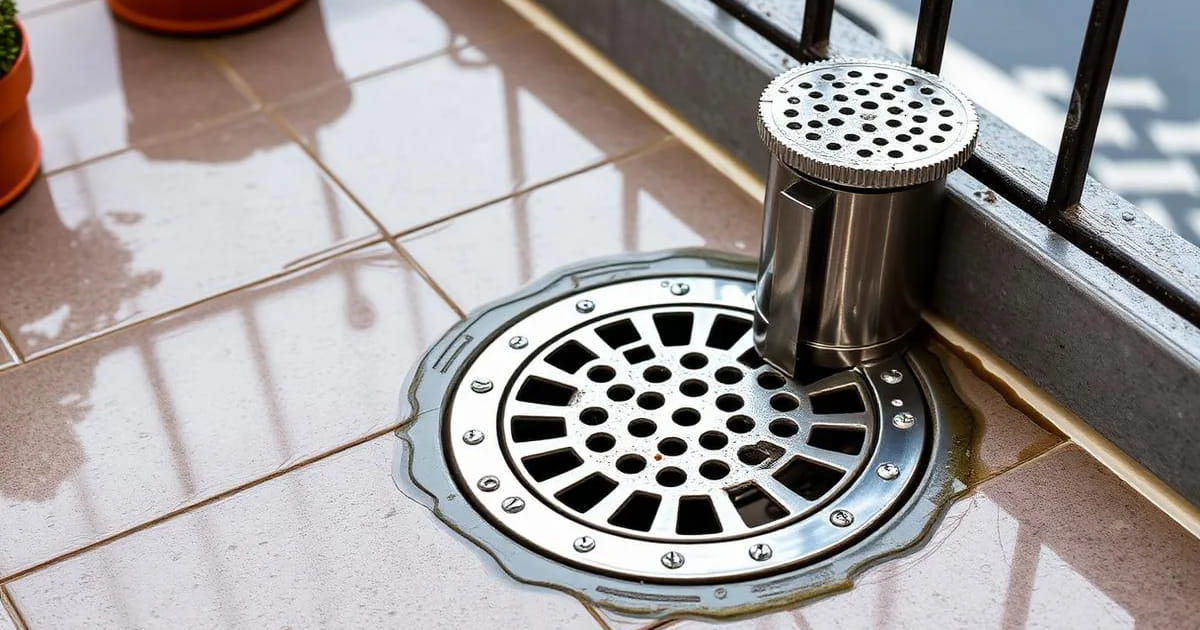
In Madeira rain does not fall gently: it arrives concentrated, with intensities that test waterproofing, fall and drain diameter all at once. When that combination is undersized, water builds up, rises above the waterproofing upstand and enters the slab. The result shows weeks later as stains on the neighbour's ceiling or salt efflorescence on a wall. This guide explains how to size, choose and maintain balcony and terrace drainage.
🌧️ Why Balcony Drainage Fails in Madeira
1) High rainfall intensity over short periods: a drain that copes in normal rain saturates during a storm. 2) A single drain with no emergency outlet: if it clogs, the balcony becomes a tank. 3) Insufficient or reversed fall, often created when new flooring is laid over the old. 4) Decorative grates with small free area, which trap leaves and form a plug. 5) Leaves, potting soil and wind-blown sand build up over summer and block on the first rainy day. 6) Undersized downpipes, or 90° bends that sharply reduce flow. 7) Waterproofing with a low upstand: just 2 cm of standing water is enough to cross the barrier.
📐 Falls and Practical Sizing
1) As a design rule, a 1% to 2% fall towards the drain is the minimum acceptable on external floors. 2) On long, narrow balconies the fall must be continuous, with no flat areas against walls or thresholds. 3) The drain goes at the true lowest point, verified with a level, never «in the middle for looks». 4) Surfaces above roughly 15 m² justify two collection points for redundancy. 5) The drained area sets the diameter: DN75 suits small balconies; larger terraces need DN90 or DN110. 6) The downpipe must maintain or increase diameter downstream, never reduce it. 7) Whenever possible we add an emergency overflow or a scupper in the parapet, so water cannot rise above the waterproof upstand.
🔧 Choosing Drains, Traps and Grates
1) Drains with PP or brass bodies and stainless steel grates cope with the island's marine environment far better than plain chromed grates. 2) An adjustable (rotating) outlet lets you align the drain with existing pipework without breaking more slab — ideal in refurbishment. 3) Horizontal outlets suit thin slabs; vertical outlets give better flow where depth is available. 4) Trapped drains prevent odours where rainwater is wrongly connected to foul drainage — a common situation that should still be corrected. 5) An anti-leaf grate or removable basket is essential on balconies with planters. 6) A flange with integrated membrane collar allows the waterproofing sheet to be bonded correctly to the drain body. 7) We avoid fixed-height grates on pedestal paving: there, height-adjustable drains are used.
🏗️ Waterproofing Connection and Structural Mistakes
1) The critical point is not the drain: it is the joint between drain and membrane. 2) The membrane must enter the drain body through the flange, bonded or welded continuously. 3) The waterproof upstand should rise at least 15 to 20 cm above finished floor level. 4) Never use silicone around the drain as a substitute for a flange — it lasts months and always fails. 5) Tiling over old flooring without rebuilding the fall creates permanent reverse slope. 6) Bonding tiles directly onto the membrane with no decoupling layer causes cracks and water paths. 7) Connecting balcony rainwater to household foul drainage is a frequent error: in heavy rain it causes backflow and indoor odours.
🔎 Diagnosing Leaks Originating on a Terrace
1) We run a flood test: plug the drain, fill the area and watch how the stain develops over hours. 2) If the stain appears only with wind-driven rain, the source is often the window frame or upstand, not the floor. 3) If it persists days after the rain stops, we assess water pipes beneath the slab. 4) A camera survey of the downpipe reveals blockages, cracks and misalignment. 5) Moisture meters and thermography help delimit the wet area before any demolition. 6) Tracer dyes confirm whether water comes from the drain, the joints or the upstand. 7) Only after this sequence do we propose work: drain replacement, localised waterproofing reinforcement, or rebuilding the fall.
✅ Preventive Maintenance Before the Rains
1) Clean grates, baskets and gutters at the start of autumn, before the first heavy rain. 2) Check for standing water 30 minutes after washing down — a sign of poor fall. 3) Test drainage with a bucket of water and time it: slow emptying indicates partial blockage. 4) Visually inspect the waterproof upstand, joints and stone trims. 5) Remove soil and leaves near planters, and never place a pot over the drain. 6) Confirm the downpipe discharges freely and not into a foul chamber. 7) In condominiums, log every cleaning: it is proof of maintenance in a claim. Have ponding or ceiling stains? Send WhatsApp photos and a video of the balcony in rain and we will assess it.
FAQ
What is the minimum fall for a balcony?
As a practical rule, 1% to 2% towards the drain with no flat areas. On long balconies we prefer a continuous 1.5%, because small settlement irregularities easily cancel a tight fall.
Is one drain enough on my terrace?
It depends on area and geometry. Above roughly 15 m², or whenever there is no emergency overflow, we recommend two collection points. Redundancy is what prevents flooding when one clogs.
Can the drain be replaced without breaking the whole slab?
In most cases yes. We use drains with adjustable outlets and a flange to bond to the existing waterproofing, working only in the surrounding area. It is the usual refurbishment solution in Funchal.
Can balcony water connect to the household drain?
It is poor practice and a frequent source of problems: heavy rain causes backflow and indoor odours. Rainwater should have its own network, separate from foul drainage.
Ponding or leaks on your balcony? Message us on WhatsApp.
We work in Funchal, Câmara de Lobos, Caniço, Santa Cruz, Machico, Ribeira Brava, Ponta do Sol, Calheta, Santana, São Vicente and across Madeira Island.