Balcony and Terrace Leaks in Madeira: How to Protect Against Rain and Strong Wind
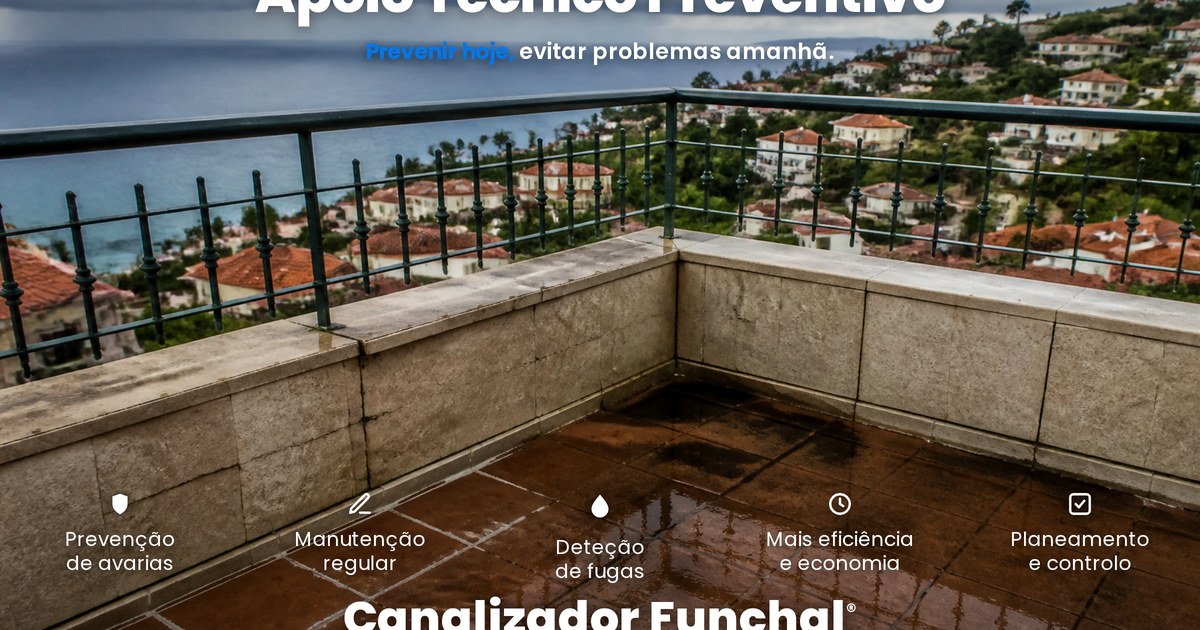
On Madeira Island, balconies and terraces are the home's first line of defence against wind-driven rain and coastal sea spray. A single crack in the tile joints or a drain blocked with leaves is enough for water to reach the slab and show up weeks later as a stain on the living room ceiling. It is a very common problem in Funchal, Ponta do Sol, Machico and Porto Moniz, where sea exposure and the intensity of autumn and winter downpours put any waterproofing to the test.
🔎 Symptoms & Initial Diagnosis
1) Damp stains and peeling paint on the ceiling of the room directly below the balcony or terrace, often near external walls and corners. 2) Efflorescence — white crystalline powder — in the joints of the outdoor tiles, a sign that water is crossing the floor and carrying salts out of the mortar. 3) Water pooling in corners or along the parapet after days of heavy rain, proof of insufficient falls or undersized drains. 4) Tiles sounding hollow when tapped, or lifting, showing water is already trapped in the bedding layer. 5) Occasional dripping onto the neighbour's ceiling below or in shared balconies, typically 24 to 72 hours after a downpour. 6) Mould patches and a damp smell in the rooms below, even on dry days.
🧪 Main Causes in Madeira
1) Constant exposure to wind-driven rain: in Madeira rain rarely falls vertically, it hits façades and parapets horizontally and gets in through details that would never fail in a sheltered location. 2) Coastal sea spray in Funchal, Machico and Porto Moniz, attacking mortars, fixings and metal profiles and accelerating the ageing of poorly chosen sealants and membranes. 3) Cracks in the mastic and tile joints caused by the island's thermal swings — strong daytime sun and rapid night-time cooling — which keep the outdoor floor expanding and contracting. 4) No waterproofing membrane under the floor: in many older buildings tiles were laid straight onto the slab, leaving watertightness dependent on the joints alone. 5) Undersized, badly placed or blocked drains, clogged with leaves, soil and pine needles, turning the balcony into a tank during heavy rain. 6) No fall towards the drain and no perimeter expansion joint, forcing the slab to crack at the same point every time. 7) Poor detailing at stone sills, parapets, thresholds and window frames — where most of the leaks we see in the region begin.
🛠️ Ideal Step-by-Step Solution
1) Inspection of the drains and downpipes, with full cleaning and flow testing: many leaks are solved right here. 2) A watertightness test, plugging the drain and holding a controlled layer of water for 24 to 48 hours while watching the ceiling below to pinpoint the exact entry point. 3) Assessment of falls and joint condition, mapping hollow areas and active cracks. 4) Substrate preparation: removing loose material, opening and repairing cracks, creating or correcting falls towards the drain with levelling mortar. 5) Application of elastic waterproofing membranes resistant to UV and sea spray, with reinforcing band around the whole perimeter, a minimum 15 to 20 cm upstand at vertical details and a reinforced wrap at the drain using a proper connection accessory. 6) Technical sealing of expansion joints and of details against stone sills and parapets, using polyurethane or high-performance hybrid sealants — never universal silicone. 7) Reinstating the floor with flexible cement adhesive and water-repellent grout, keeping the perimeter expansion joint, or applying a continuous liquid trafficable system when the tiles are to be kept. 8) Final verification with the next downpour or a hose test and, where window frames are affected, reinforcement of the channels and weep holes.
🎯 The Definitive Technical Solution
1) Reinforced two-component elastic membrane: re-grouting the tiles does not solve the problem long term. The definitive fix requires applying, under the ceramic finish, a two-component cement-polymer elastic membrane reinforced with fibreglass mesh, running up at least 15 cm on side walls and skirtings to form a continuous waterproof "tank". 2) Perimeter and intermediate movement joints: mandatory, filled with a polyethylene backer rod and sealed with polyurethane (PU) mastic. This lets the ceramic expand with the heat without cracking or debonding the waterproof layer. 3) Correct fall and drainage: ensure a minimum fall of 1.5% to 2% towards the drains and use floor gullies with double drainage, draining water at tile surface level and also the moisture trapped under the adhesive.
🚫 What to AVOID
1) Applying ordinary paints or off-the-shelf "waterproof coatings" over damp surfaces without fixing the leak at source: moisture is sealed inside, the coating blisters within months and the problem returns worse. 2) Blocking, reducing or covering the balcony drains with planters, badly supported decking or tight grates — with no drainage, any waterproofing eventually fails. 3) Using universal silicones in areas under continuous solar radiation and sea spray: they lose elasticity, turn brittle and split within two seasons. 4) Laying new tiles over old ones with no membrane and no expansion joint, adding weight and keeping water trapped. 5) Sealing the entire balcony perimeter so trapped water has no way out. 6) Postponing the repair until after winter: every rain cycle widens cracks and reaches the slab reinforcement, turning a waterproofing job into a far more expensive structural repair.
🧰 Preventive Maintenance
1) Regular cleaning of terrace drains and gutters before Madeira's rainy season, typically in September and October, and again mid-winter where there are trees. 2) An annual check of outdoor floor joints and of details against stone sills, parapets and thresholds, redoing the sealing whenever fine cracks appear. 3) Periodic washing of surfaces exposed to sea spray in coastal areas, to reduce salt build-up in joints and fixings. 4) A visual inspection after storms with strong wind, looking for hollow tiles, standing water and new stains on the ceiling below. 5) A year-by-year photographic record of the balcony's condition, useful for shared buildings and insurance claims. 6) Renewing the waterproofing system within the manufacturer's service life, rather than waiting for the first ceiling stain — prevention always costs a fraction of the repair.
FAQ
Does re-grouting the tiles fix a balcony leak?
No. Re-grouting is only a stopgap: grout is neither waterproof nor elastic and cracks again with thermal movement. The definitive fix is a two-component elastic membrane reinforced with fibreglass mesh, running 15 cm up the skirtings, plus movement joints sealed with PU mastic.
Why do balcony tiles always crack or lift in the same spot?
Because there is no movement joint. Without perimeter and intermediate joints using a polyethylene backer rod and PU mastic, the ceramic expands in the sun and the stress always releases at the weakest point, cracking and debonding the waterproofing beneath.
Do all the tiles have to come up to waterproof a balcony?
Not always. When tiles are well bonded and the falls are correct, a continuous liquid trafficable system — an elastic membrane reinforced at joints, upstands and the drain — can be applied over the existing floor, avoiding heavy work. Full removal is only justified when large areas are hollow or lifting, when the slab has no fall towards the drain, or when the watertightness test shows water already moving through the bedding layer. In Funchal, Ponta do Sol and Machico we solve many cases without stripping everything, but that decision is only reliable after an on-site inspection and test.
Does sea spray damage terrace seals in Funchal?
Yes. In the coastal areas of Funchal, Machico and Porto Moniz, salts carried by sea spray settle in joints, fixings and sealant beads, and combined with intense solar radiation they accelerate the loss of elasticity. Universal silicones turn brittle within one or two seasons and open cracks invisible to the naked eye. That is why we use membranes and sealants with declared UV and saline resistance, reinforce details at stone sills and parapets, and recommend periodic washing of exposed surfaces.
How long after the rain does the ceiling stain appear?
Usually 24 to 72 hours after heavy rain, because water travels through the bedding layer and the slab before reaching the plaster of the ceiling below. That delay leads many people to blame the plumbing rather than the balcony. A watertightness test with a controlled layer of water tells the two causes apart within a few days and avoids opening walls unnecessarily.
Stains on the ceiling below your balcony? Message us on WhatsApp and book an inspection.
We diagnose and repair balcony and terrace leaks in Funchal, Caniço, Santa Cruz, Machico, Câmara de Lobos, Ribeira Brava, Ponta do Sol, Calheta, Santana, São Vicente and Porto Moniz, across Madeira Island.