Automatic Water Shut-Off at the Meter: Stopping the Flood Before the Damage
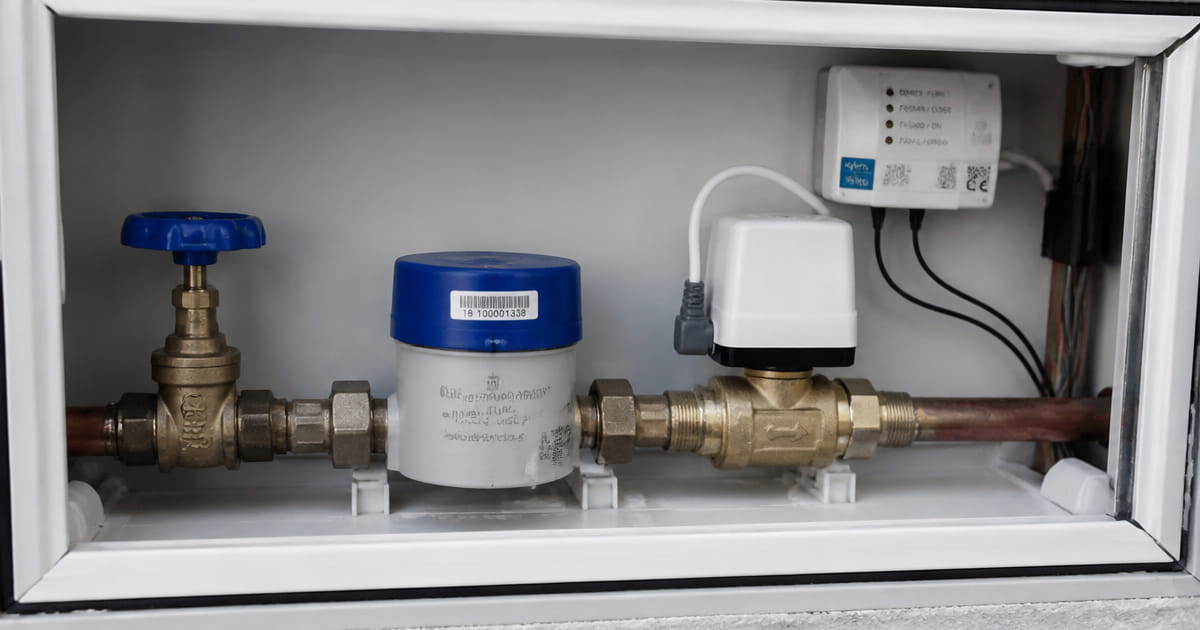
Most water damage we attend in Funchal is not the result of a slow, discreet leak but of a fast event: a tap hose that bursts, a washing machine connection that lets go, a pipe that fails inside a wall. Within minutes hundreds of litres enter the home and the problem stops being plumbing and becomes floors, the neighbour's ceiling and furniture. A shut-off system at the meter solves exactly that critical window: it detects, decides and closes the water before anyone gets home.
💧 Damage Is Always About Time, Not Flow
1) A burst DN8 flexible hose typically discharges 8 to 15 litres per minute at mains pressure. 2) In 30 minutes that is 300 to 450 litres — enough to travel through a slab. 3) Replacing the hose costs tens of euros; drying floors and repainting the neighbour's ceiling costs thousands. 4) Nobody is present at the right moment: it happens at night, at the weekend, or with the house closed. 5) The only variable you can control is how long the water runs. 6) That is precisely what an automatic shut-off system does: it turns hours of leak into seconds.
⚙️ How the Motorised Valve Works
1) A motorised ball valve is fitted at the property inlet, immediately after the meter. 2) A small electric motor turns the ball 90° in 3 to 8 seconds, giving full closure rather than reduced flow. 3) Power is usually low-voltage 12 V or 24 V from a supply near the board or inside the meter cabinet. 4) The control unit receives the sensor signals and issues the close command. 5) Good units include a manual emergency lever so the valve can be operated during a power failure. 6) Status (open/closed) is shown by LED and, on connected models, in the app.
🔌 Wired Floor Sensors and Why They Are More Reliable
1) A wired sensor is simply a pair of electrodes that close a circuit when a film of water reaches the floor. 2) No batteries, no pairing loss, no dependency on a wireless network. 3) Cable runs can reach tens of metres, covering the whole home from a single controller. 4) They sit at floor level, at the lowest point, next to the water heater, washing machine, sink and shower tray. 5) The circuit is extra-low voltage, safe in wet areas. 6) In new build or refurbishment the cable is concealed; in existing homes we use trunking or a technical skirting run.
🚨 The Closing Sequence in Practice
1) The sensor detects electrical continuity through the water and reports to the controller in under a second. 2) The controller validates the signal to avoid false positives from condensation or floor washing. 3) The close command goes to the valve motor and the supply is cut within seconds. 4) The system raises a local audible alarm and, if connected, a phone notification. 5) Reopening is always manual and deliberate: only after the cause is found and fixed. 6) Many systems log the event with date and time, which is useful for the insurance claim.
📏 Sizing and Madeira-Specific Details
1) Match the valve size to the inlet — usually DN20 or DN25 — to avoid pressure loss. 2) Prefer low-lead brass bodies approved for drinking water. 3) In high-pressure areas combine the system with a pressure-reducing valve: high pressure is the main cause of burst hoses. 4) Meter cabinets in Madeira are often external and salt-exposed — demand adequate ingress protection and sealed connections. 5) Leave a union on each side of the valve so it can be replaced without cutting pipe. 6) Check access: the manual lever must be reachable without tools.
🛠️ Installation, Testing and Annual Servicing
1) Before installing we check the condition of the main stopcock and the meter. 2) The motorised valve is fitted with a particle filter upstream, protecting the ball from grit and swarf. 3) We finish with a real test: each sensor is wetted and the time to full closure is timed. 4) We also test behaviour on power loss and the manual emergency operation. 5) Once a year the valve is fully cycled so limescale cannot seize the ball. 6) Want to protect your home or holiday let? Message us on WhatsApp and we will assess your meter cabinet on site.
FAQ
Does the system close the water during a power cut?
The units we install hold their last position on power loss and allow immediate manual operation. Where the risk justifies it we add backup power to guarantee closure.
Can it close by mistake when washing the floor?
The controller validates the signal before acting and sensors are placed away from normal washing areas. In practice false positives are rare and are always signalled by alarm.
Does installation require building work?
No. The valve goes into the meter cabinet or at the property inlet and sensor cables run along skirting or trunking. In a typical home it is done the same day.
Is it worth it in a rented or holiday apartment?
Especially so: those are exactly the properties where nobody is present to close the water. It is the best cost-to-damage-avoided ratio we know of.
Want automatic water shut-off fitted at your meter? Message us on WhatsApp and we will assess your installation.
We work in Funchal, Câmara de Lobos, Caniço, Santa Cruz, Machico, Ribeira Brava, Ponta do Sol, Calheta, Santana, São Vicente and across the whole island of Madeira.