Looped Irrigation Pipework: The Difference Between Watering and Watering Well
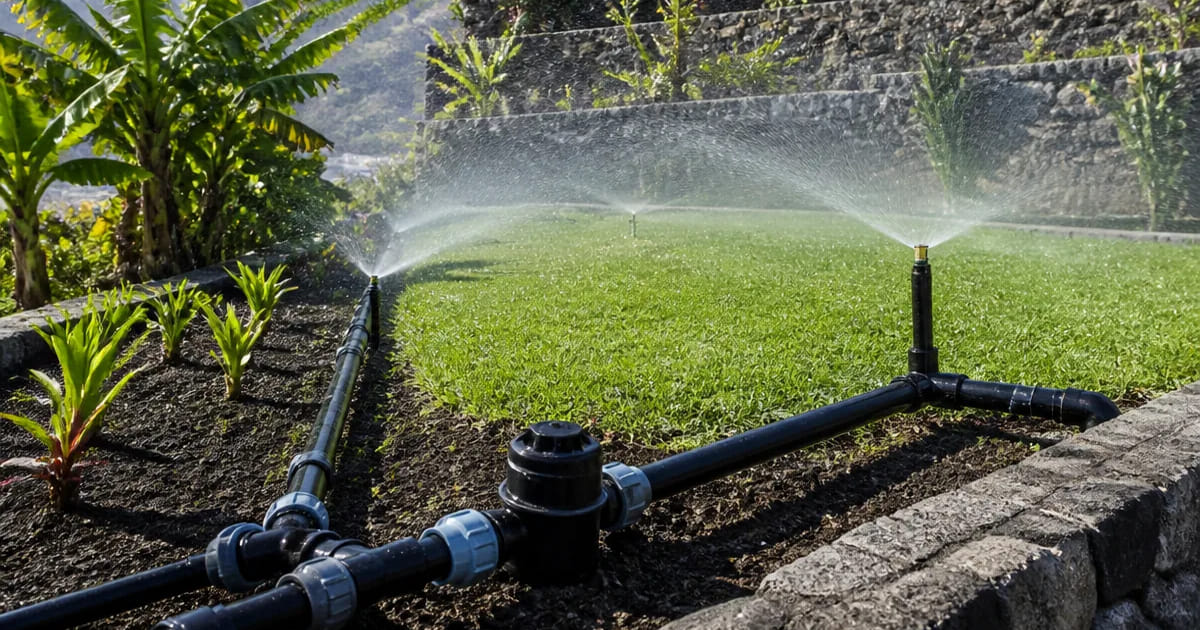
Almost every irrigation system we inspect in Madeira shares the same original flaw: the pipework was run «in line» — a single branch leaving the solenoid valve and feeding sprinkler after sprinkler until it dead-ends. The outcome is always the same: the first heads spray hard and the last ones barely lift off the ground. It is not a lack of water or a faulty controller — it is physics. The professional answer is a closed ring circuit (a pressurised loop), and it completely changes the hydraulic behaviour of the installation.
🔁 The Common Mistake: Straight Line vs. Closed Loop
In a straight-line layout, all the water travels one single path and loses energy along the way. 1) Every metre of pipe, every elbow and every tee consumes pressure through friction — this is dynamic friction loss. 2) Because each sprinkler draws flow, the next section works with less water and less pressure than the one before. 3) At the dead end it is common to measure under 1.5 bar where the head needs 2 to 3 bar to open its full arc. 4) The garden ends up waterlogged near the valve and yellow at the far corner. 5) In a looped circuit the pipe leaves the valve, runs around the irrigated area and returns to the starting point: every emitter is now fed from two directions in parallel. 6) Flow splits between the two legs, water velocity drops, friction loss falls sharply and pressure stays practically identical at 100% of the emitters.
📐 Why the Loop Equalises Pressure
Friction loss does not grow in proportion to flow — it grows roughly with the square of it. 1) Split the flow between two legs and each carries half, so the loss in each drops to about a quarter. 2) The loop behaves like two half-lines meeting at the hydraulically most distant point. 3) That meeting point is the only minimum-pressure spot in the system — and still far higher than the equivalent dead end. 4) In practice we keep pressure deviation below 10% between the first and last sprinkler. 5) That means equal throw radii, correct head-to-head overlap and lower water consumption, because you no longer over-water just to compensate the weak zones.
⛰️ Madeira's Terrain: Slope, Water Hammer and Anti-Drain Valves
The island's topography adds a factor that is almost always overlooked: static pressure changes with elevation. 1) Every 10 metres of height difference is worth around 1 bar — on terraced ground the lower zone can receive 2 bar more than the upper one. 2) Zoning by elevation (never mixing very different terrace levels in one zone) is the first design rule. 3) Fast valve closure on columns with height difference causes water hammer — the banging that cracks fittings and blows joints apart. 4) We prevent it with slow-closing solenoid valves, flexible connections, air release valves at high points and, where needed, an expansion vessel or an upstream pressure reducer. 5) On sloping branches, sprinklers and drippers with anti-drain check valves are mandatory: without them the whole pipe empties through the lowest emitters at the end of every cycle, creating puddles, washing out soil and filling the line with air. 6) A pipe that empties is also a pipe that sucks debris in through the nozzles — the silent cause of half the clogged spray heads we service.
🧩 Critical Components: Valves, Reducers and Filtration
Good hydraulic layout only pays off with the right hardware. 1) 24V AC solenoid valves are the standard for mains-powered controllers: robust, with progressive closing solenoids and manual flow regulation. 2) 9V DC latching solenoid valves are the choice for battery controllers in areas without power — typical on Madeira smallholdings, levada plots and farmland. 3) Drip irrigation works between 1 and 2.5 bar: above that, drippers pop off fittings or emit unevenly. Always fit a dedicated pressure reducer on the drip zone. 4) Levada, well or tank water requires 120 mesh disc filtration (about 125 micron) ahead of any drip zone. 5) Disc filters beat plain screens because they trap particles in depth and strip down in seconds for rinsing. 6) Complete the assembly with a per-zone isolation valve, a low-point drain and an accessible valve box — easy maintenance is maintenance that actually gets done.
🧰 Preventive Maintenance Guide
A well-built system still needs routine — especially with Madeira's hard water and strong sun. 1) Quarterly, unscrew the spray nozzles and soak them in citric acid or vinegar solution to dissolve the limescale that closes the fan pattern. 2) Rinse the filter discs at least monthly during the watering season and always after heavy rain clouds the levada. 3) Purge air by opening the last emitter of each loop at season start: trapped air cuts flow and causes uneven spray. 4) Check real pressure with a gauge in the valve box — a sudden drop means a buried leak, a rise means a blocked zone. 5) At winter shutdown, close the supply, drain the low points and protect controllers and exposed pipework. 6) Pipe left in the sun degrades under UV: bury it, use UV-stabilised pipe or cover it with bark mulch. 7) Test every zone manually in early spring before trusting the controller.
🚫 What to AVOID
1) Do not feed 15 sprinklers from one dead-end branch just to save pipe. 2) Do not mix sprinklers and drip on the same zone — they need incompatible pressures and run times. 3) Do not skip the filter on well or levada water: a single drip zone will clog within weeks. 4) Do not install emitters without anti-drain valves on sloping ground. 5) Do not leave black pipe exposed to the sun for years without UV protection. 6) Do not ignore banging when zones shut off — water hammer always breaks something eventually.
FAQ
Is it worth converting an existing straight-line system into a loop?
In most cases yes, and without redoing everything: you simply run an extra length of pipe from the dead end back to the starting point, closing the ring. It is a quick intervention that usually restores the performance of the last sprinklers immediately.
What pressure should I have at the solenoid valve outlet?
Rotors and spray heads typically need 2 to 3.5 bar; drip irrigation works between 1 and 2.5 bar. If the mains or tank deliver more than 4 bar, fit an upstream pressure reducer to protect fittings and emitters.
Why do drippers clog so quickly on levada water?
Levada water carries fine sand, algae and organic matter that pass straight through coarse screens. A 120 mesh disc filter, rinsed regularly, solves practically every case we see in Madeira.
Uneven watering or weak sprinklers? We design and correct looped irrigation systems across Madeira.
We work in Funchal, Câmara de Lobos, Caniço, Santa Cruz, Machico, Ribeira Brava, Ponta do Sol, Calheta, Santana, São Vicente and across the whole island of Madeira.