Asbestos Cement Sewer Pipes: The Silent Threat of Roots and Petrified Grease
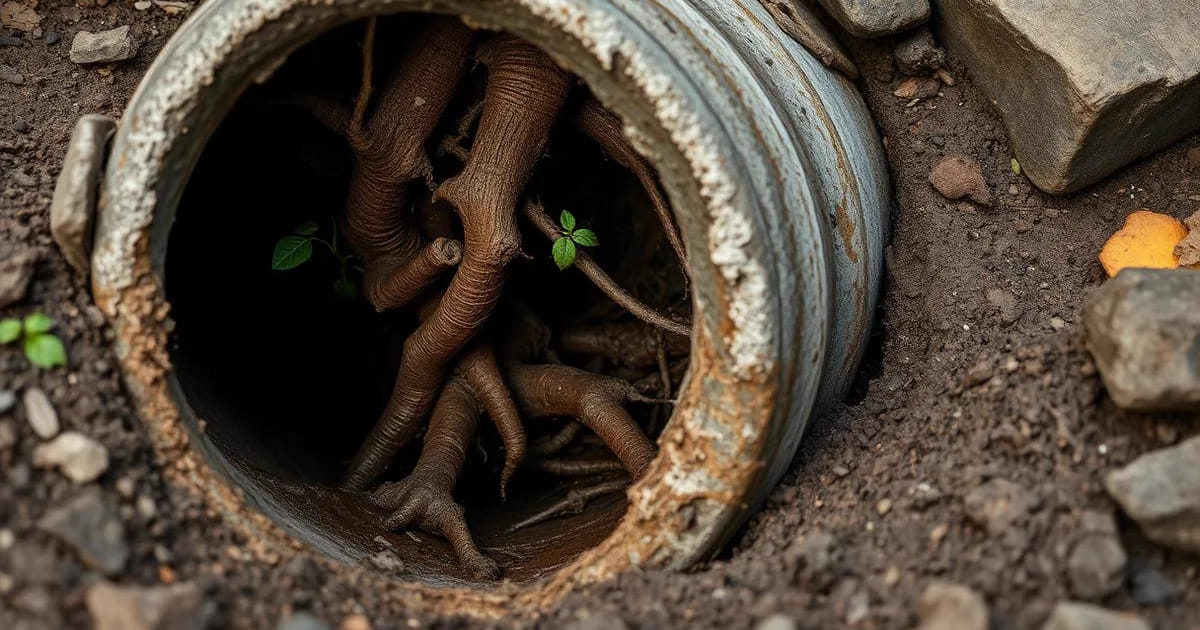
In many older houses and buildings across Madeira, the main sewer line is still built from fibre-cement or vitrified clay pipe. Although these materials were the standard for decades, their porosity and joint design create serious vulnerabilities over time.
🌱 How Roots Attack Old Pipes
Unlike modern smooth-wall PVC, cement pipe has permeable joints. 1) Trees and garden vegetation search the soil for moisture. 2) Hairline cracks and worn cement joints release that moisture, drawing roots in. 3) Once inside, roots branch out and form a net that catches paper and solids. 4) Continued growth widens the crack and eventually displaces the joint, causing leaks into the ground. 5) Where fig trees, bougainvillea or palms grow near the line, the risk is far higher.
🧫 Grease Absorption and Petrification
1) The rough, porous internal surface lets kitchen grease cling to the pipe wall. 2) Over the years that grease reacts with calcium and minerals in the water and 'petrifies' into a hard crust. 3) The usable diameter shrinks progressively until full blockage. 4) The effect worsens on branches with low slope or low use. 5) The crust also traps grit and debris, so blockages return faster each time.
🚩 Warning Signs Not to Ignore
1) Recurring blockages always at the same point in the house. 2) Slow draining across several fixtures at once. 3) Gurgling drains and persistent smells. 4) Unusually green vegetation or damp soil along the sewer route. 5) Slight sinking of paving, driveway or garden near the chambers.
🎯 The Definitive Technical Solution
In the past the only option was breaking floors, gardens and paving to replace the whole line. Today Canalizador Funchal® starts with a robotic video inspection that pinpoints exactly where roots enter and where the grease block sits. High-pressure hydro-jetting follows, with dedicated cutting nozzles able to shear roots and dissolve petrified grease without damaging the pipe structure. When the pipe is already cracked or has displaced joints, we assess a localised replacement of that section in smooth-wall PVC — only the length needed, leaving the rest of the run intact.
🚫 What to AVOID
1) Do not use acids or aggressive chemical drain cleaners: they attack cement joints and worsen leaks. 2) Do not force metal snakes blindly into cement pipe — they can puncture or crack it. 3) Do not plant aggressive-rooted trees over the sewer route. 4) Do not pour cooking oils and fats down the sink. 5) Do not ignore repeat blockages: they are a structural symptom, not bad luck.
🧰 Preventive Maintenance
1) Preventive hydro-jetting every 2 to 3 years on properties with old lines. 2) Camera inspection after any serious blockage, to record the real pipe condition. 3) Fit a grease trap in heavy-use kitchens or holiday rentals. 4) Use filtered sink strainers and clean traps regularly. 5) Keep the photo record and technical report from the inspection — useful for the building management or insurer.
FAQ
Do I have to replace all the cement pipework?
Usually not. The camera inspection shows whether the pipe is merely blocked or structurally compromised. Where the walls are sound, hydro-jetting solves it; only cracked sections or displaced joints justify a localised replacement.
Will the roots grow back after cleaning?
They can if the moisture entry point is not fixed. That is why, after cutting the roots, we assess the originating joint or crack and recommend sealing or replacing that section, plus periodic preventive cleaning.
Root or grease blockages in an old sewer line? We provide camera inspection and hydro-jetting across Madeira.
We work in Funchal, Câmara de Lobos, Caniço, Santa Cruz, Machico, Ribeira Brava, Ponta do Sol, Calheta, Santana, São Vicente and across Madeira island.