Airlocks in Solar Thermal Risers and Heat Pumps: Why Hot Water Never Reaches Your Taps
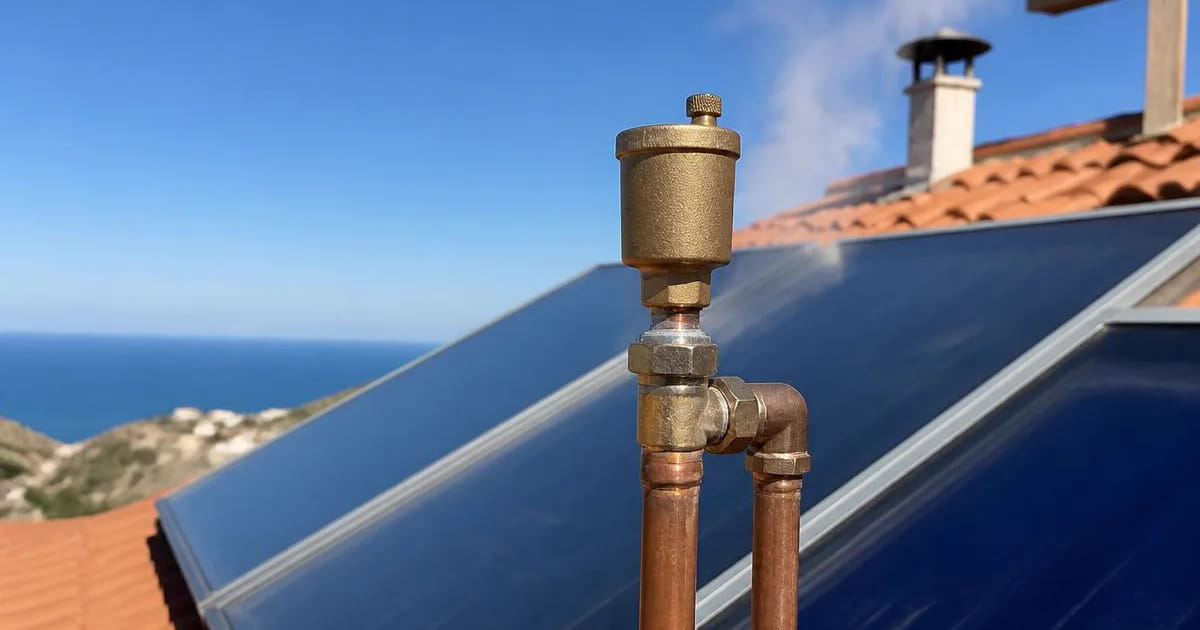
It is one of the cases that most confuses owners in Madeira: the solar thermal panel sits under intense sunshine, the rooftop cylinder reads high temperatures, the heat pump runs normally — yet the water reaching the shower or the kitchen is lukewarm or plainly cold. The first instinct is to blame the equipment and ask for a replacement quote. In most Canalizador Funchal® interventions, however, the equipment is perfectly healthy: what fails is circulation. A pocket of air trapped at the highest point of the circuit — the so-called airlock — interrupts flow and stops the heat produced up there from coming down to the outlets. It is a silent problem, cheap to solve when diagnosed early and expensive when left to drag on, because it destroys panels, pumps and heating elements.
☀️ The Symptom: Heat on the Roof, Lukewarm Water at the Taps
The signature of this problem is the contrast between the temperature measured at the equipment and the temperature arriving at the house. 1) The solar cylinder thermostat reads 60 °C or more, but the tap gives lukewarm water. 2) Hot water takes an extremely long time to arrive, or arrives in bursts alternating hot and cold. 3) Bubbling or running-water noise is heard inside the pipes even with every tap closed. 4) The circulation pump runs noisily, with a metallic 'gravel' sound instead of the usual soft hum. 5) Hot water flow is visibly lower than cold water flow at the same basin. 6) The problem gets worse on the hottest days, precisely when the system should perform best. 7) After a street water cut or a maintenance job, the symptom appears suddenly — a clear sign of air introduced into the circuit.
🫧 The Airlock Phenomenon: How It Forms
Air does not appear by magic: it forms and accumulates for well-known physical reasons. 1) Water contains dissolved gases (oxygen, nitrogen, carbon dioxide) released as temperature rises — the hotter the water, the lower the solubility. 2) In the solar panel or the heat pump exchanger, water reaches the highest temperatures of the whole circuit, so that is where most gas is released. 3) Micro-bubbles rise naturally and gather at the highest point of the riser, usually an elbow on the roof or the top of the technical column. 4) When the accumulated volume exceeds the pipe section, a column of compressed air forms and acts as a plug. 5) In a thermosiphon system (natural circulation), the density difference is not enough to push that plug and circulation simply stops. 6) In a forced system, the pump tries to push but air is compressible: energy is wasted compressing and decompressing the pocket. 7) Mains water cuts, draining for maintenance and fast refills introduce extra air, making the problem immediately worse.
🔥 Risks: Overheating, Cavitation and Premature Wear
An airlock is not merely a comfort nuisance — it is a real threat to the equipment. 1) Without circulation, the fluid inside the solar panel keeps absorbing radiation and enters stagnation, reaching temperatures well above 150 °C. 2) Stagnation degrades the glycol (loss of antifreeze properties and acidification), burns seals and can warp the absorber. 3) The primary circuit safety valve discharges and releases fluid, leaving the system with insufficient pressure once it cools. 4) The circulation pump, running dry or with an air-water mix, cavitates: the rotor erodes and the bearing overheats. 5) Dry running destroys the pump's ceramic bushing within a few weeks. 6) On heat pumps, insufficient flow causes short cycling, compressor wear and high-pressure alarms. 7) The electric backup element runs permanently to compensate, driving up the electricity bill without anyone understanding why.
🔍 Differential Diagnosis: Air, Limescale or a Closed Valve?
Before purging, it is essential to confirm that air really is the cause. 1) We measure flow and return temperatures with a contact thermometer: with an airlock, the difference is abnormally large or zero (fluid stopped). 2) We check cold primary circuit pressure — values below the recommended range indicate fluid loss and air ingress. 3) We listen to the riser with a hydraulic stethoscope to locate the point where flow disappears. 4) We confirm that every isolating valve is actually open — more common than it sounds after building works. 5) We distinguish it from limescale: a scale obstruction gives reduced but constant flow, while air gives intermittent flow with bubbling. 6) We run the circulation pump at maximum speed to see whether the plug shifts temporarily. 7) We inspect existing air vents: many are blocked by limescale, corroded or were installed in the wrong place.
🛠️ Professional Solution: Air Vents, Pressurised Purging and Expansion Vessel
A definitive fix combines three lines of work. 1) We install high-temperature automatic air vents, with a forged brass body and built-in check valve, rated for solar panel stagnation temperatures. 2) We place the vents at the genuinely highest points of the circuit and at the elbows where air tends to settle — position matters more than the component brand. 3) Whenever the pipe layout justifies it, we add a micro-bubble separator on the hot flow, continuously removing dissolved air before it can group together. 4) We carry out a pressurised purge: forced filling with a high-flow pump that drags the plug out instead of compressing it. 5) We check and calibrate the expansion vessel nitrogen pre-charge, matching it to the installation's actual static head — an uncalibrated vessel causes pressure swings that suck air back in. 6) We restore cold service pressure and the correct glycol concentration in the primary circuit. 7) We finish with a full thermal test, comparing flow/return temperatures and confirming pump stability at all speeds.
⚠️ Mistakes to Avoid
Many interventions fail because of shortcuts that only postpone the problem. 1) Do not fit ordinary domestic automatic air vents on solar circuits: they burst or jam at stagnation temperatures. 2) Do not purge the circuit at midday under strong sun — serious risk of steam burns and thermal shock to the panel. 3) Do not fill the system with a hose at high speed: it drags bubbles in instead of expelling them. 4) Do not ignore the expansion vessel pre-charge; without it, the purge lasts only weeks. 5) Do not replace the circulation pump before eliminating the air — the new pump will cavitate in exactly the same way. 6) Do not close manual purge valves 'to stop them dripping': you remove the circuit's only air outlet. 7) Do not dilute glycol with ordinary mains water in hard-water areas: it accelerates deposits and worsens the obstruction.
🗓️ Preventive Maintenance in Madeira
In Madeira, intense sun, varying altitude and hard water demand regular follow-up. 1) Annual check of primary circuit pressure and expansion vessel pre-charge. 2) Functional test of automatic air vents, cleaning the seat and float. 3) Glycol analysis (pH and freezing point) every two years, especially in installations above 500 metres of altitude. 4) Cleaning of the particle filter upstream of the circulation pump. 5) Recording flow and return temperatures under full sun for year-on-year comparison. 6) Inspection of outdoor thermal insulation, degraded by UV radiation and salt in coastal areas. 7) Preventive purge after any public mains cut or plumbing work in the building.
FAQ
Why is the solar panel hot but the water only lukewarm?
Because the heat is not being transported. An air pocket at the highest point of the circuit stops circulation (natural or forced), so the energy stays trapped in the panel instead of coming down to the cylinder and the taps.
Can I purge the solar system myself?
It is not advisable. On a sunny day the primary circuit can be above 100 °C under pressure, and opening a vent can spray steam and boiling fluid. Besides, without calibrating the expansion vessel the air returns within weeks.
How long does it take to clear an airlock?
A pressurised purge with pressure checks typically takes 1 to 2 hours. If high-temperature automatic air vents must be installed or the expansion vessel replaced, the job can extend to half a day.
Can an airlock damage the heat pump?
Yes. Insufficient flow causes short cycling, high-pressure alarms and accelerated compressor wear. In circuits with a circulation pump, running with an air-water mix causes cavitation and destroys the rotor.
Need help now? Fast response on WhatsApp.
We work in Funchal, Câmara de Lobos, Caniço, Santa Cruz, Machico, Ribeira Brava, Ponta do Sol, Calheta, Santana, São Vicente and across the whole island of Madeira.